
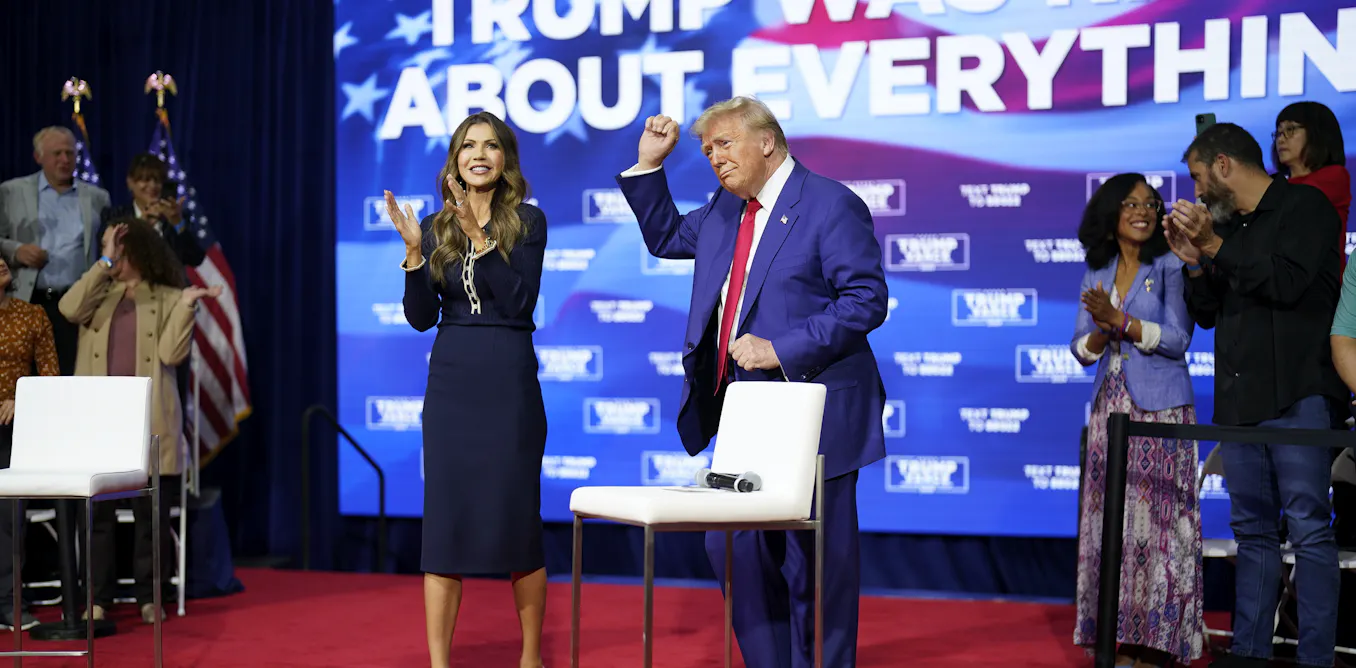
The Surreal Soundtrack of Politics: Trump’s Musical Town Hall
On October 14, 2024, in Oaks, Pennsylvania, Donald Trump turned a typical town hall meeting into a musical spectacle that has been described as “surreal” and “bizarre.” After two attendees experienced medical issues, Trump made a surprising pivot: he declared that he would cease answering audience questions and instead play music from his self-curated rally playlist. For the next 39 minutes, the former president swayed and bopped to the tunes, occasionally stopping to speak, transforming the political event into what felt like a living-room listening session.
The playlist featured a mix of nostalgic hits, including the Village People’s “YMCA” and Sinead O’Connor’s poignant “Nothing Compares 2 U.” This unconventional approach to a political gathering raises questions about the role of music in campaigns and how it can influence voter engagement.
The Tradition of Music in Campaigns
The use of music in political campaigns is not new; it has a long-standing tradition. However, Trump’s event may mark a unique moment where a playlist took precedence over traditional talking points. As the 2024 election looms, both Democrats and Republicans are strategizing for what appears to be a tightly contested race, potentially decided by a few hundred thousand votes in key states. In this context, every voter matters, and the methods of reaching them are evolving.
While Trump was dancing to his favorite tracks, Democrats were also tapping into pop culture, particularly through football and the music of Taylor Swift. The Harris-Walz campaign, for instance, has embraced endorsements from 15 Pro Football Hall of Famers and is even selling Swiftie-style friendship bracelets on its campaign website. Swift herself has publicly endorsed Kamala Harris, further intertwining pop culture with political strategy.
Pop Culture and Political Strategy
Tim Walz, the Democratic vice-presidential candidate, has highlighted his background as a football coach, using it as a bridge to connect with voters. In the vice-presidential debate, he mentioned both his coaching experience and Taylor Swift, showcasing how candidates are increasingly blending their personal narratives with cultural references to resonate with the electorate.
Colin Allred, a Democratic challenger and former NFL player, is also leveraging his football background in his campaign to unseat GOP Senator Ted Cruz in Texas. His ads feature him in football gear, emphasizing his athletic past as a means to connect with voters.
The Impact of Pop Culture on Elections
The effectiveness of linking campaigns to pop culture is a topic of ongoing debate. Historical examples provide insight into how cultural references can influence voter perception and engagement.
Reagan and Springsteen
One of the most notable instances of a candidate attempting to harness pop culture was Ronald Reagan’s 1984 campaign, where he cited Bruce Springsteen as a symbol of hope. However, Springsteen famously rejected Reagan’s request to use his song “Born in the U.S.A.” on the campaign trail, as its lyrics tell a more somber story of a Vietnam veteran’s struggles. Despite Reagan’s landslide victory, this moment arguably pushed Springsteen into the political arena, transforming him into a vocal supporter of the Democratic Party.
Springsteen and Kerry
Springsteen’s political activism continued when he supported John Kerry in the 2004 election, participating in the “Vote for Change” tour. Kerry himself attempted to connect with voters through cultural references, although his efforts sometimes backfired, such as when he flubbed sports references during the campaign. While he won key states like Wisconsin and Massachusetts, he ultimately lost the election, highlighting the risks associated with cultural missteps.
Harding, Jolson, and the Cubs
Long before Reagan, Warren Harding’s 1920 campaign featured visits from celebrities like Al Jolson and even the Chicago Cubs, demonstrating that the intersection of politics and popular culture has deep roots in American history. Harding’s campaign was marked by a front porch strategy that capitalized on celebrity appearances, contributing to his significant electoral victory.
Bill Clinton and MTV
In the 1992 election, Bill Clinton made a concerted effort to connect with younger voters by appearing on MTV and playing the saxophone on “The Arsenio Hall Show.” While the direct impact of these appearances is hard to quantify, they helped Clinton resonate with a demographic that had previously felt disconnected from politics, leading to a surge in support among young voters compared to his predecessor.
Ford and Football
Gerald Ford, who played football at the University of Michigan, also utilized his athletic background during his presidency. While he didn’t lean into pop culture as heavily as some of his successors, he did engage with football culture, even campaigning alongside famed Alabama coach Paul “Bear” Bryant. However, Ford ultimately lost the 1976 election to Jimmy Carter, suggesting that while cultural connections can enhance a campaign, they are not always a guarantee of electoral success.
The Future of Pop Culture in Politics
As the Harris-Walz campaign seeks to attract young voters through pop culture, the potential for success remains uncertain. Swift’s fanbase, primarily young suburban women, represents a demographic that could sway the election. Meanwhile, the NFL’s diverse fanbase offers another avenue for outreach. Candidates believe that engaging with pop culture can generate attention and coverage, even if it doesn’t directly influence voter decisions.
In an era where political discourse is increasingly intertwined with cultural references, the strategies employed by candidates like Trump, Walz, and Allred reflect a broader trend of using music and pop culture to connect with voters. Whether these efforts will translate into votes remains to be seen, but one thing is clear: the soundtrack of politics is evolving, and candidates are ready to dance to its beat.